
I don’t know about you, but I am tired of the two loudest messages about aging.
One says getting older is a raw deal. A slow decline. A shrinking life. A problem nobody wants but everyone eventually gets.
The other says aging is acceptable only if we fight it hard enough. Hack the system. Optimize every cell. Track every metric. Turn “anti-aging” into a second career.
To me, neither one feels like the whole truth.
And then there is the old favorite: “70 is the new 40.”
I am no mathlete, but even I know that 70 is not the same as 40.
And thank goodness for that.
Forty is forty. Seventy is seventy. That is not a problem. But believing that one is far better than the other is the lie that our ageist culture perpetuates.
When we insist that one age has to impersonate another in order to be valued, we send a pretty terrible message. We suggest that the age we are now is not quite acceptable unless it can be compared to an age we have already lived through.
What a strange thing to do to ourselves.
Seventy does not need to borrow dignity from forty. It gets to be seventy, with its own wisdom, losses, humor, beauty, freedom, aches, perspective, and power.
That’s the whole point. Aging well does not mean pretending we are not aging. It means refusing to treat the age we are now as some kind of consolation prize.
Most of us would never speak to a friend the way we speak to ourselves about aging.
We tell ourselves we’re getting worse. We assume every ache means we’re falling apart. We decide a forgotten word is proof we’re losing our edge. We look in the mirror and speak to ourselves like a critic, not a companion, and then we wonder why aging starts to feel so heavy.
Aging requires adaptation. Some of that adaptation needs to happen in our internal narrative.
The older adults I work with often tell me that one of the hardest parts of aging is managing the commentary running quietly in the background of the mind. The little conclusions like, “I’m not useful anymore,” “I don’t matter in this culture,” or “If I can’t do it the way I used to, I’ve failed.”
But those messages are not facts.
They are habits and the good news is that habits can be challenged.
So here is my assignment for you this month. Please, try it for one week.
When you catch yourself thinking an unhelpful thought about aging, do not argue with it. Just answer it with something steadier.
Instead of:
“My body feels like it is falling apart.”
Try:
“My body is changing, and that’s normal. I can work with the changes instead of fighting them.”
Instead of:
“I’m not as sharp anymore, so I shouldn’t speak up.”
Try:
“My perspective still matters.”
Instead of:
“It’s too late to make new friends.”
Try:
“Friendship can begin at any age.”
Instead of:
“My best days are behind me.”
Try:
“Some good days are behind me, and some are still mine to make.”
This is the work I do with the older adults I see in my practice, and this is the work I want you to be willing to do on your own behalf.
I am not asking you to pretend everything is easy. I am not asking you to force optimism you do not feel. I am asking you to stop narrating your life as if it is already over.
Because it is not over until it is really over.
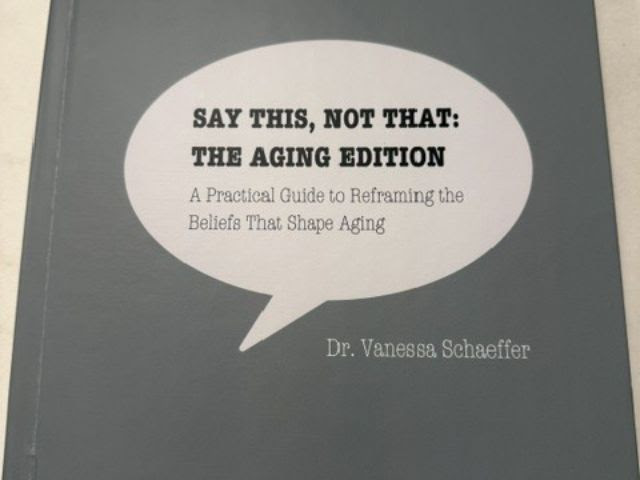
This is exactly why I wrote Say This, Not That: A Practical Guide to Reframing the Beliefs That Shape Aging. It is a handbook of the thoughts so many people carry quietly, paired with clear revisions that help you respond with more steadiness, self-respect, and truth.
The book is built on evidence-based strategies that help people notice and challenge the negative thinking patterns that can shape how we feel, cope, and move through life. It teaches the habit of using language that helps you remember this:
You are not your worst thought.
And aging is not the end of your story.
This month, pay attention to the sentence you say to yourself when you notice you are aging.
Then rewrite it.
One line at a time.
You are not done yet and that is a very good message to give yourself.
If you are interested in learning more about this book, please head over to my website: www.gainesvillepsychologist.com/shop
Until next time, dear reader, remember you are worth so much more than a consolation prize.